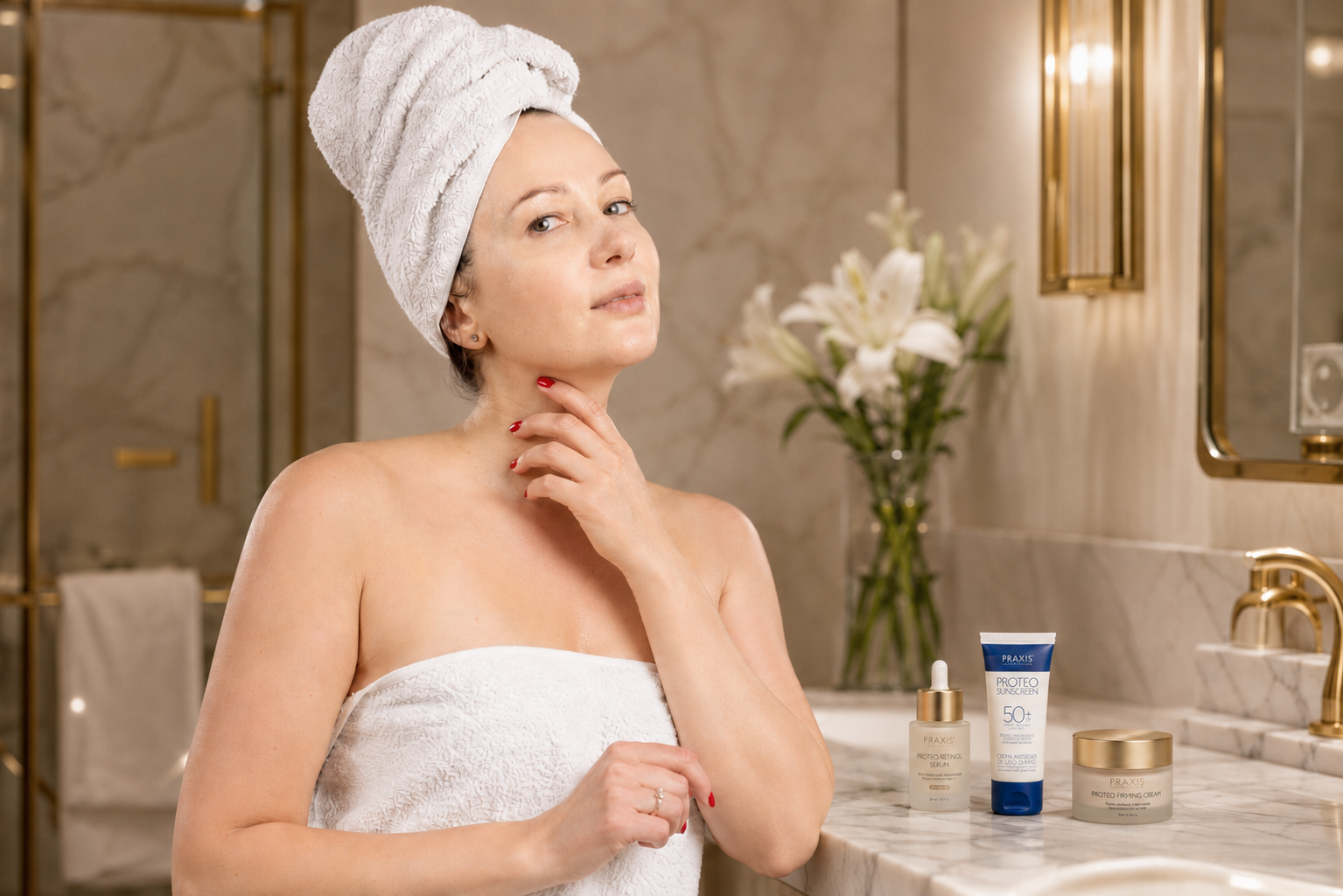
The skin barrier is the outermost layer of the skin — the stratum corneum — and acts as a shield against the environment. It is made up of cells (corneocytes) held together by essential lipids such as ceramides, cholesterol, and free fatty acids [1].
When it functions well, the skin retains moisture and tolerates cosmetics without issues. When it is compromised, redness, tightness, flaking, and increased sensitivity appear.
Sensitive vs. Sensitized Skin: They Are Not the Same
Many people believe they have “sensitive skin” when in reality they have a compromised skin barrier caused by over-exfoliation, overuse of active ingredients, or aggressive cleansing. The difference is important: sensitized skin is a temporary condition that can improve when barrier function is restored.
🧴 Sensitive Skin
This is a genetic condition characterized by constant reactivity to environmental factors and cosmetics. Sensitive skin tends to redden, itch, or become irritated easily.
Dermatology Times, 2025 [2]
⚠️ Sensitized Skin
This is a temporary condition caused by external factors: excessive exfoliation, use of aggressive active ingredients, inadequate cleansing, or environmental changes. It is reversible with proper care.
Journal of Cosmetic Dermatology, 2024 [3]
The Big Mistake: Doing Too Much
Increasingly intensive routines — multiple serums, acids, and retinoids combined — are the primary cause of a compromised barrier.
The American Academy of Dermatology (AAD) warns that indiscriminate exfoliation can damage the skin and cause irritation, especially if sensitizing active ingredients are already being used [4].
💡 More products does not mean better results.
Signs That Your Skin Barrier May Be Compromised
These signs are very recognizable and usually appear in combination [5]:
Constant Tightness
Skin does not retain moisture well
Stinging When Applying Products
Even those you previously tolerated well
Redness and Flaking
Sign of superficial inflammation
Increased Overall Reactivity
Skin is in defense mode
How to Care for the Skin Barrier and Key Ingredients
The first measure is always to simplify. A simpler routine with a gentle cleanser, moisturizer, and sunscreen is usually enough for the skin to recover [6].
Most Effective Ingredients to Strengthen the Barrier
🧪 Ceramides
Restore essential lipids and reduce transepidermal water loss (TEWL) [7].
Make up 50% of the lipids in the stratum corneum
💊 Niacinamide
Improves barrier function and calms visible sensitivity. Stimulates ceramide biosynthesis [8].
Form of vitamin B3 with anti-inflammatory action
💧 Hyaluronic Acid
Provides immediate surface hydration. Attracts and retains water on the skin’s surface [9].
Key humectant for dehydrated skin
🌿 Panthenol
Soothes reactive skin. Accelerates skin barrier repair [10].
Provitamin B5 with regenerating action
☀️ Daily sun protection: Essential. UV radiation is one of the main factors that deteriorates the skin barrier [11].
Clinical Evidence & Scientific Research
Ceramides and Barrier Function
Study: “Considering Phytosphingosine-Based Ceramide Formulations for Atopic Skin Care”
Source: Dermato, MDPI AG (2024)
Findings: Ceramides CER[EOP], CER[NP], and CER[AP] maintain skin barrier homeostasis.
Their imbalance contributes to atopic diseases such as eczema
[1].
Niacinamide and Barrier Repair
Study: “Niacinamide – Properties and Uses”
Source: Polish Journal of Cosmetology (2025)
Findings: Niacinamide stimulates ceramide and lipid biosynthesis,
strengthening the skin barrier and reducing water loss [8].
Endogenous Lipids and Repair
Study: “Recovery Effects of Skin Lipid Components on Skin Barrier Damage”
Source: International Journal of Cosmetic Science (2025)
Findings: Creams with ceramides and behenic acid significantly improved
barrier recovery in SDS-damaged skin [7].
Scientific Advances in Skin Barrier Repair
🔬 Saponins and Epidermal Repair
Recent research demonstrates that total saponins repair the epidermal barrier by regulating multiple signaling pathways, including PI3K-AKT and MAPK, improving the expression of barrier proteins such as Filaggrin, Involucrin, and Loricrin [12].
🧬 Oligopeptide-215 and Homeostasis
Oligopeptide-215, a biomimetic derived from amphibian secretions, regulates skin barrier homeostasis through simultaneous modulation of JAK-STAT and NF-κB pathways, restoring barrier proteins and suppressing inflammatory responses [3].
🌿 Sesamol and Barrier Protection
Sesamol, a compound derived from sesame, regulates AQP3 and HAS2 expression through the MAPK pathway, increasing hyaluronic acid secretion and protecting against inflammatory damage and photoaging [9].
Conclusion: The Foundation of Any Effective Routine
The skin barrier is the foundation of any effective routine. When balanced, the skin appears more hydrated, resilient, and comfortable.
Caring for it doesn’t mean doing less, but doing it more wisely: cleanse gently, moisturize well, and give active ingredients the space they need.
✨ Every skin has different needs. At Laboratorios Praxis, we formulate with dermocosmetic criteria to respect skin physiology and adapt to its real needs.
📚 Bibliography & Scientific References
- Mijaljica D, et al. “Considering Phytosphingosine-Based Ceramide Formulations for Atopic Skin Care.” Dermato. 2024;4(1):5-22. doi:10.3390/dermato4010002
- Dermatology Times. “Standard of Care of Sensitive Skin.” Dermatology Times. 2025. View article
- Zhang Q, et al. “Dual-Targeting Oligopeptide-215 Regulates Skin Barrier Homeostasis Through Concurrent Modulation of JAK-STAT and NF-κB Signaling.” J Cosmet Dermatol. 2026. PMID: 41858149
- American Academy of Dermatology (AAD). “How to care for your skin barrier.” AAD Public Resources. 2024.
- CU Medicine Dermatologists. “Tips on Protecting Your Skin Barrier.” CU Medicine Health Insights. 2025. View article
- Vogue. “How to Keep Your Skin Soft and Flake-Free.” Vogue. 2026. View article
- Wiley Online Library. “Recovery effects of various skin lipid components and their structural derivatives on skin barrier damage.” International Journal of Cosmetic Science. 2025. doi:10.1111/ics.70023
- Werner A, Erkiert-Polguj A. “Niacinamide – properties and uses.” Polish Journal of Cosmetology. 2025;28(2):49-55. View article
- Springer. “Sesamol regulates AQP3 and HAS2 via MAPK signaling for skin barrier protection.” Scientific Reports. 2025;15:45590. doi:10.1038/s41598-025-29463-8
- ScienceDirect. “Evaluating the effect of moisturizers containing endogenous lipids on skin barrier properties.” Journal of Dermatological Science. 2024. View article
- THIP Media. “What is skin barrier function? How to maintain it naturally?” THIP Media. 2025. View article
- Xie A, Wu J, Huang Q. “Total Saponins Repair the Epidermal Barrier by Regulating a Multi-Pathway Network.” Open Library of Bioscience. 2025. View publication
Ready to Strengthen Your Skin Barrier?
Discover our products formulated with ceramides, niacinamide, and hyaluronic acid to restore and protect your skin barrier.
Written by PRAXIS
Laboratorios Praxis – Skin Care & Aesthetics since 1993